

Blog
Semax vs. N-Acetyl Semax Amidate
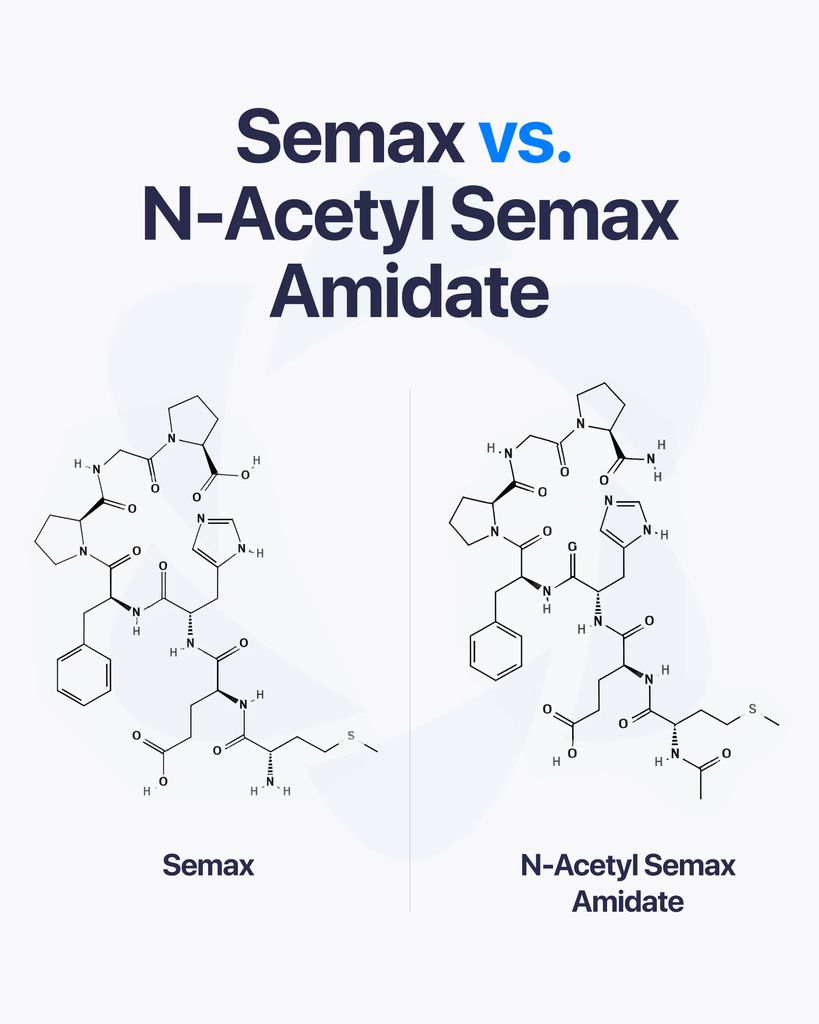
What Is Semax?
Semax is a synthetic heptapeptide (Met-Glu-His-Phe-Pro-Gly-Pro) derived from an ACTH(4–7) fragment extended by Pro-Gly-Pro. It has been examined in lab settings for effects on neural pathways and enzyme interactions, and its sequence/chemistry are well described in the peptide literature. (Reference: Magrì et al., 2016)
What Is N-Acetyl Semax Amidate?
N-Acetyl Semax Amidate (often written Ac-Semax-NH₂) features the same seven-amino-acid backbone as Semax but with N-terminal acetylation and C-terminal amidation. These terminal caps are common peptide modifications explored to affect stability and handling in experimental systems. (Reference: Magrì et al., 2016)
How Do They Differ Chemically?
-
Backbone: Identical sequence (MEHFPGP). (Reference: Magrì et al., 2016)
-
Termini: Semax has free N- and C-termini; N-Acetyl Semax Amidate is acetylated (N-cap) and amidated (C-cap), a change often investigated to influence enzymatic susceptibility and physicochemical behavior in assays. (Reference: Magrì et al., 2016)
How Have They Been Studied in Research?
Semax (foundational studies): Early work characterized sequence, enzyme sensitivity, and degradation pathways in blood/serum, indicating prominent roles for aminopeptidases in N-terminal cleavage of Semax and related fragments. (Reference: Potaman et al., 1991; 1993) (link 2)
N-Acetyl Semax Amidate (terminally modified analog): Acetylating Semax’s N-terminus alters metal-ion coordination and downstream properties in vitro; this has been used as a model to study how terminal capping can change peptide behavior in cell and coordination assays. (Reference: Magrì et al., 2016)
Delivery/stability context (literature overview): Reviews of intranasal peptide research and peptide-delivery strategies note terminal modifications (including N-acetylation) and formulation approaches as ways to explore stability during experimental handling; some reports specifically mention acetylated Semax among promising candidates for such work. (Reference: Shevchenko et al., 2019)
Advantages in Laboratory Context
-
Defined Backbone With a Well-Documented Parent Peptide
Semax’s sequence and degradation pathways are described across multiple studies, providing a clear baseline for comparative experiments. (Reference: Potaman et al., 1991; 1993) (link 2)
-
Terminal Modifications Enable Controlled Comparisons
Using N-Acetyl Semax Amidate allows researchers to isolate the impact of capping on coordination chemistry or assay stability without changing the primary sequence. (Reference: Magrì et al., 2016)
-
Method Development
Reviews highlight terminal modification as one of several knobs (alongside carriers and excipients) for exploring peptide handling and recovery in in vitro or model-delivery setups. (Reference: Shevchenko et al., 2019)
Limitations to Keep in Mind
-
Enzymatic Susceptibility (Parent Peptide): Semax is susceptible to aminopeptidases and other enzymes; experimental design often accounts for this during incubations or biological-media exposure. (Reference: Potaman et al., 1991; 1993) (link 2)
-
Altered Interactions (Modified Analog): N-terminal acetylation can change metal-binding modes and related readouts, so results may diverge from the parent peptide in specific assays. (Reference: Magrì et al., 2016)
-
Heterogeneous Literature Footing: Semax has a longer publication history than its acetyl-amidated analog; direct head-to-head datasets are comparatively limited in the public literature. (Reference: overview across sources above)
