

Blog
What Is High Performance Liquid Chromatography (HPLC)?
What Is High Performance Liquid Chromatography (HPLC)?
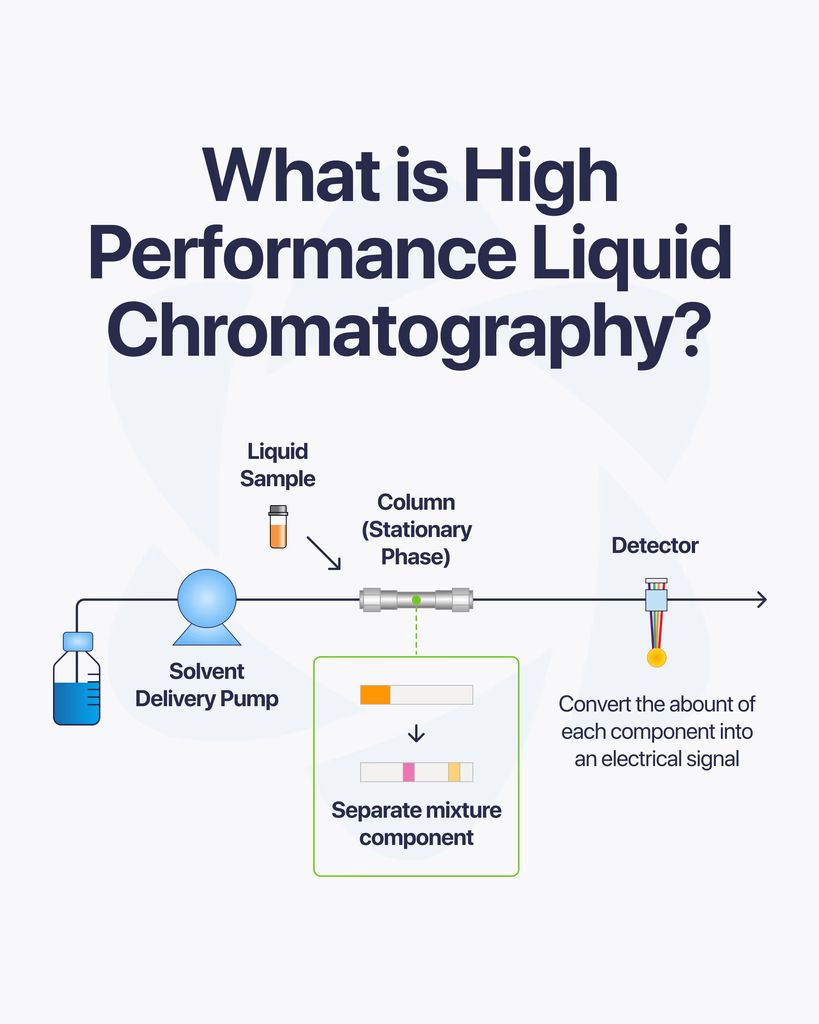
High Performance Liquid Chromatography (HPLC) is an analytical technique used to separate, identify, and quantify components in a mixture. It works by passing a liquid sample through a column packed with a stationary phase, while a high-pressure pump drives the solvent (mobile phase). Different compounds interact with the stationary phase at varying strengths, causing them to exit the column at different times — a principle known as retention time.
How Is HPLC Used in Research?
HPLC is widely applied across scientific fields. In peptide and pharmaceutical research, it is commonly used to:
-
Verify purity of synthesized compounds.
-
Separate peptide fragments or analogs.
-
Detect small concentrations of impurities.
-
Prepare samples for further structural or biological testing.
(Reference: Kazakevich & LoBrutto, 2007)
Key Features of HPLC
Researchers value HPLC because it offers:
-
High Resolution – Ability to separate closely related compounds with precision.
-
Quantitative Accuracy – Provides reliable concentration data for analytes in complex mixtures.
-
Versatility – Can analyze peptides, proteins, metabolites, and small organic molecules.
-
Scalability – Methods can be adapted from microgram-level analysis to preparative purification.
(Reference: Swartz & Krull, 2012)
What Researchers Have Observed
Studies using HPLC have consistently reported its usefulness in quality control and characterization of peptides. For instance, peptide research often employs reverse-phase HPLC to confirm purity above 98–99%, while analytical runs allow scientists to detect even trace contaminants. Beyond peptides, HPLC has been applied to track metabolic intermediates, assess drug stability, and monitor chemical synthesis efficiency.
